
Does Marriage Counseling Work? What Scientific Research Says

Does marriage counseling work? Yes, scientific research shows that marriage counseling significantly improves relationship satisfaction, communication, and emotional connection. A 2020 scientific review found that up to 80% of distressed couples benefit from evidence-based approaches to couples therapy. However, no treatment can guarantee that a marriage will survive.
As a marriage and family therapist, I’ve seen how difficult relationship problems can become when they’re left unresolved. But I’ve also seen how understanding each other and making meaningful changes can help couples move forward.
In this article, I’ll look at what scientific research actually says about marriage counseling, including success rates, the factors that influence results, and when counseling is most likely to help.
Table Of Contents:
Does Marriage Counseling Actually Work?

Yes, marriage counseling does work for many couples, and decades of scientific research support its effectiveness. Studies have found that couples therapy can improve relationship satisfaction, communication, emotional intimacy, and the ability to resolve conflict.
However, it’s important to understand what successful marriage counseling actually looks like.
For some couples, success means rebuilding trust after infidelity. For others, it means learning how to communicate without every disagreement turning into an argument. Sometimes, it’s about reconnecting emotionally after years of growing apart.
I don’t believe success should be measured solely by whether a couple stays married. A couple can remain together while continuing to feel unhappy or disconnected. Instead, I look for meaningful improvements in how couples communicate, understand each other’s needs, manage disagreements, and maintain emotional closeness.
What Does Scientific Research Say About Marriage Counseling?
The scientific evidence is positive. Multiple studies have found that marriage counseling can produce measurable improvements in relationship satisfaction, communication, and emotional intimacy.
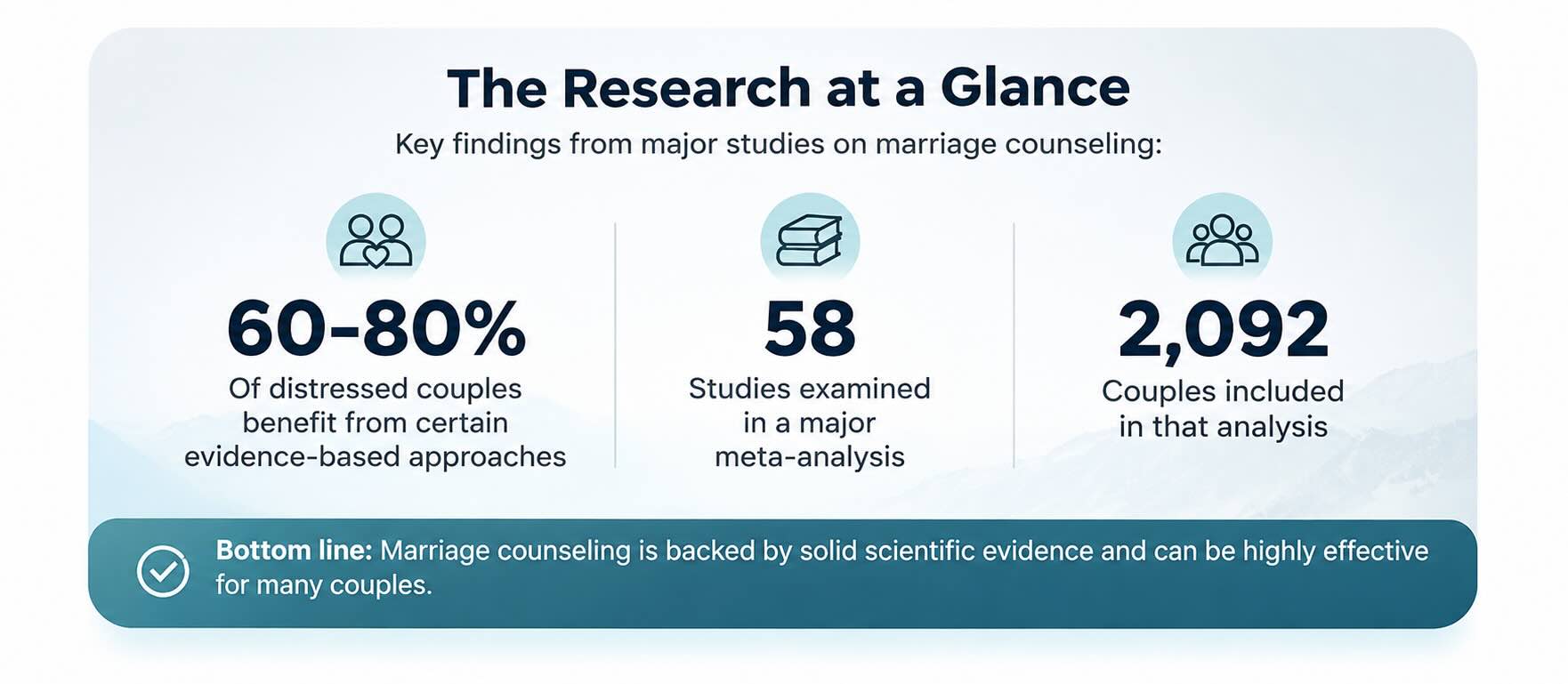
What Is the Success Rate of Marriage Counseling? A 2020 review published in the Annual Review of Clinical Psychology found that up to 80% of distressed couples benefit from behavioral and emotion-focused couples therapy.
However, the researchers also noted that improvements can fade when couples don’t maintain the changes they’ve made. I think this is an important finding. Marriage counseling helps couples make meaningful progress, but lasting improvements often require continued effort outside the therapy room.
What Large-Scale Studies Tell Us
One of the most comprehensive studies was a 2020 meta-analysis published in the Journal of Consulting and Clinical Psychology.
Researchers analyzed 58 studies involving 2,092 couples and found that:
- Couples receiving therapy experienced substantial improvements in relationship satisfaction.
- Couples placed on waiting lists showed no statistically significant improvement in relationship satisfaction.
- Therapy produced measurable improvements in communication, emotional intimacy, and relationship behaviors.
- Many improvements were maintained during follow-up periods.
When Does Marriage Counseling Not Work?

Marriage counseling doesn’t work for every couple, particularly when one partner is unwilling to participate, has already decided to leave, or refuses to take responsibility for their behavior.
Ongoing dishonesty, infidelity, and a lack of commitment can also make rebuilding trust extremely difficult. In relationships involving abuse or controlling behavior, traditional couples counseling may be unsafe, and individual support should take priority.
I believe marriage counseling offers the best chance of success when both partners are willing to make changes. However, even when a marriage cannot be saved, counseling can still help couples gain clarity and make healthier decisions about their future.