
Does Marriage Counseling Work? What Scientific Research Says

Couple reaching toward each other with hands almost touching, symbolizing hope and rebuilding connection in marriage counseling.

Does marriage counseling work? Yes, scientific research shows that marriage counseling significantly improves relationship satisfaction, communication, and emotional connection. A 2020 scientific review found that up to 80% of distressed couples benefit from evidence-based approaches to couples therapy. However, no treatment can guarantee that a marriage will survive.

As a marriage and family therapist, I’ve seen how difficult relationship problems can become when they’re left unresolved. But I’ve also seen how understanding each other and making meaningful changes can help couples move forward.

In this article, I’ll look at what scientific research actually says about marriage counseling, including success rates, the factors that influence results, and when counseling is most likely to help.

Table Of Contents:

Does Marriage Counseling Actually Work?

Young married couple in their 30s reconnecting through conversation, illustrating how marriage counseling can improve communication and emotional connection.

Yes, marriage counseling does work for many couples, and decades of scientific research support its effectiveness. Studies have found that couples therapy can improve relationship satisfaction, communication, emotional intimacy, and the ability to resolve conflict.

However, it’s important to understand what successful marriage counseling actually looks like.

For some couples, success means rebuilding trust after infidelity. For others, it means learning how to communicate without every disagreement turning into an argument. Sometimes, it’s about reconnecting emotionally after years of growing apart.

I don’t believe success should be measured solely by whether a couple stays married. A couple can remain together while continuing to feel unhappy or disconnected. Instead, I look for meaningful improvements in how couples communicate, understand each other’s needs, manage disagreements, and maintain emotional closeness.

What Does Scientific Research Say About Marriage Counseling?

The scientific evidence is positive. Multiple studies have found that marriage counseling can produce measurable improvements in relationship satisfaction, communication, and emotional intimacy.

What Is the Success Rate of Marriage Counseling? A 2020 review published in the Annual Review of Clinical Psychology found that up to 80% of distressed couples benefit from behavioral and emotion-focused couples therapy.

However, the researchers also noted that improvements can fade when couples don’t maintain the changes they’ve made. I think this is an important finding. Marriage counseling helps couples make meaningful progress, but lasting improvements often require continued effort outside the therapy room.
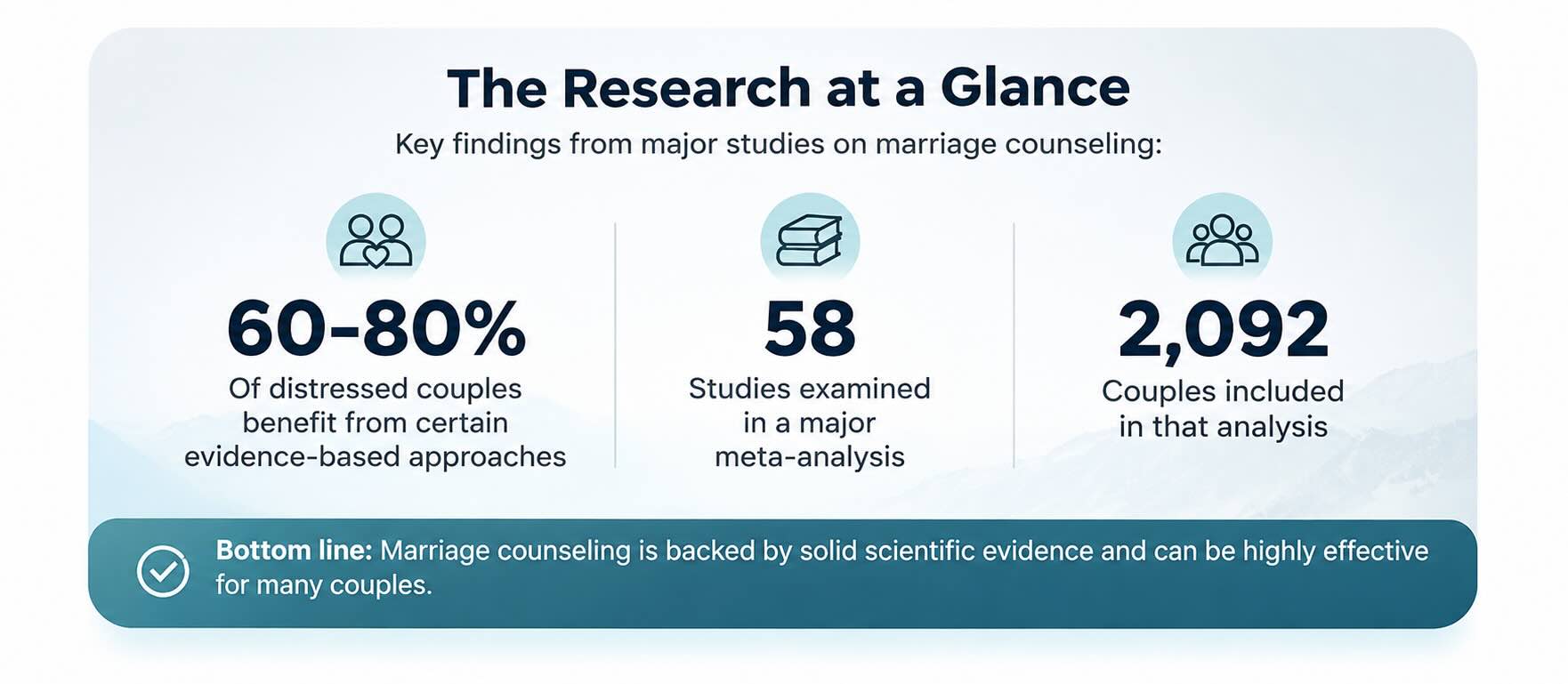
Marriage counseling research statistics showing 60–80% of distressed couples benefit from certain therapies and a meta-analysis of 58 studies involving 2,092 couples.

What Large-Scale Studies Tell Us

One of the most comprehensive studies was a 2020 meta-analysis published in the Journal of Consulting and Clinical Psychology.

Researchers analyzed 58 studies involving 2,092 couples and found that:

  • Couples receiving therapy experienced substantial improvements in relationship satisfaction.
  • Couples placed on waiting lists showed no statistically significant improvement in relationship satisfaction.
  • Therapy produced measurable improvements in communication, emotional intimacy, and relationship behaviors.
  • Many improvements were maintained during follow-up periods.

What Factors Influence Whether Marriage Counseling Works?

In my experience, success depends on how committed both partners are, the problems they’re facing, and their willingness to make changes. Here are five factors that I have seen influence the outcome.

1. Both Partners’ Motivation
Marriage counseling works well when both partners genuinely want to improve their relationship. They don’t need to agree on everything, but both should be willing to participate and work toward a solution.

2. Waiting Too Long to Seek Help
Many couples wait until their marriage reaches a breaking point before seeking help. By then, years of resentment, poor communication, and emotional distance can make rebuilding the relationship more challenging. I always encourage couples to address problems early.

3. Commitment to the Process
Attending counseling sessions is only part of the solution. Couples also need to apply what they learn in everyday life. Small, consistent changes in communication and behavior can make a significant difference over time.

4. Severity of Relationship Problems
Couples dealing with communication difficulties may face different challenges from those experiencing infidelity, addiction, or longstanding conflict. However, research suggests that even highly distressed couples can make significant improvements through therapy.

5. The Therapist’s Experience
Working with a qualified marriage counselor who uses evidence-based approaches can improve the quality of treatment. It’s also important that both partners feel comfortable, understood, and supported throughout the process.

Ultimately, marriage counseling works best when both partners are committed to improving their relationship and willing to put what they learn into practice.

When Does Marriage Counseling Not Work?

Marriage counseling doesn’t work for every couple, particularly when one partner is unwilling to participate, has already decided to leave, or refuses to take responsibility for their behavior.

Ongoing dishonesty, infidelity, and a lack of commitment can also make rebuilding trust extremely difficult. In relationships involving abuse or controlling behavior, traditional couples counseling may be unsafe, and individual support should take priority.

I believe marriage counseling offers the best chance of success when both partners are willing to make changes. However, even when a marriage cannot be saved, counseling can still help couples gain clarity and make healthier decisions about their future.

Marriage Counseling at Lion Counseling

I’m Mark Odland, a Licensed Marriage and Family Therapist and founder of Lion Counseling in Duluth, Minnesota. With over 20 years of experience, I’ve helped individuals and couples work through relationship difficulties, rebuild trust, and develop healthier ways to communicate.

At Lion Counseling, I believe marriage counseling should go beyond simply talking about problems. My team and I focus on understanding the underlying issues, breaking unhealthy patterns, and helping couples make meaningful, lasting changes.

We offer in-person counseling in Duluth, Minnesota, and online sessions where our clinicians are licensed. For couples who want to incorporate their Christian faith, we also offer Christian Marriage Counseling.

If you’re wondering whether marriage reset counseling could help your relationship, I encourage you to take the first step. Contact Lion Counseling to schedule a free consultation and find out how we can help.

Frequently Asked Questions

What Is the Success Rate of Marriage Counseling?

Research suggests that approximately 60% to 80% of distressed couples benefit from evidence-based marriage counseling, particularly behavioral and emotion-focused approaches. However, this doesn’t mean that 60% to 80% of marriages are saved from divorce. Success is generally measured through improvements in relationship satisfaction, communication, and emotional connection.

At What Age Do Most Marriages Fail?

According to research from Bowling Green State University, the median age for a first divorce in the US was 43.3 for men and 41.9 for women. Additionally, Pew Research Center found that 40% of divorces occurred within the first 10 years of marriage. I believe these statistics show that relationship difficulties can arise at any age, making early intervention important.

What Is the #1 Divorce Cause?

A national US survey by the National Fatherhood Initiative found that lack of commitment was the most commonly reported reason for divorce (73%), followed by excessive arguing (56%) and infidelity (55%). Although there is no single cause of divorce, I believe these findings highlight the importance of commitment, communication, and addressing relationship problems early.

Does Marriage Counseling Work After Infidelity?

Yes, marriage counseling can help couples rebuild their relationship after infidelity, although recovery isn’t guaranteed. I believe rebuilding trust requires honesty, accountability, and a genuine commitment from both partners. Counseling provides an opportunity to address the betrayal, understand underlying relationship problems, and determine whether moving forward together is possible.

Can Marriage Counseling Make Things Worse?

Marriage counseling can bring uncomfortable emotions and unresolved problems to the surface, which may temporarily increase tension. However, discussing difficult subjects is often part of making progress. In relationships involving abuse, intimidation, or controlling behavior, traditional couples counseling may be unsafe, and individual support should take priority.

How Many Sessions Does Marriage Counseling Take?

The number of sessions depends on the couple and the difficulties they’re experiencing. A 2026 study found that couples attended an average of approximately 12 therapy sessions. Some couples may need fewer sessions, while others benefit from longer-term support. I believe the focus should be on meaningful progress rather than reaching a particular number of appointments.

Can Marriage Counseling Work if Only One Person Wants It?

Marriage counseling is generally more effective when both partners are willing to participate. However, if your spouse refuses to attend, individual counseling can still help you improve communication, understand your relationship, and make healthier decisions. While you can’t force your partner to change, you can work on your own responses and behaviors.

Share This Story, Choose Your Platform!